Research
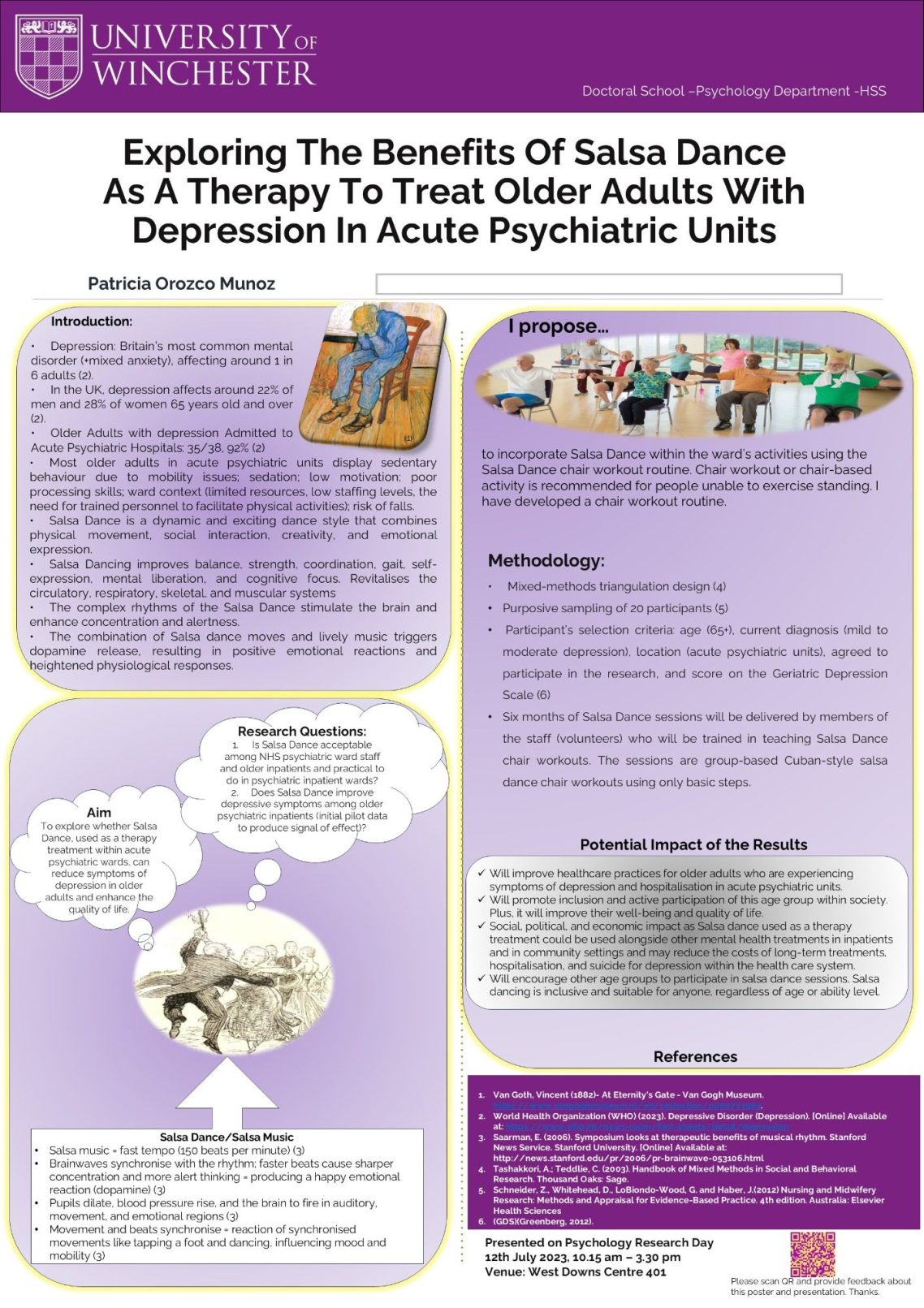
My First Poster 12th July 2023
What Is Special About Salsa Dance?
Salsa dancing, with its rich history and global appeal, is more than just a dance form; it is a vibrant expression of culture, emotion, and health benefits. Originating in the 1920s in Eastern Cuba, salsa has evolved into a global phenomenon.
1. The Historical Roots of Salsa
Salsa’s foundations developed as a synthesis of African rhythms and Spanish-Caribbean traditions in the early 20th century. The rhythmic music that inspired the dance had been popular since the 1910s, with roots in African drumbeats and Spanish melodies (Boggs, 1992). In the 1970s, salsa’s popularity surged, thanks to Cuban and Puerto Rican musicians in New York City. These artists incorporated elements of mambo, cha-cha-chá, and son, creating a distinct and dynamic style that quickly spread across the United States and beyond (Roberts, 1999)
One intriguing aspect of salsa is its name. Though it is widely accepted that the dance is named after salsa music, the origin of the term remains unclear. Some theorists propose that the name reflects the "spicy" and "hot" nature of the dance, while others compare the dance to the culinary salsa, which is a blend of various ingredients (Boggs, 1992). This mystery adds to the allure of salsa’s history.
2. Cultural Fusion and Diversity
Salsa’s appeal lies in its rich cultural fusion. The dance incorporates elements of tango, mambo, flamenco, and Afro-Caribbean traditions, with regional variations such as Cuban, Miami-style, Afro-Latino, and Colombian salsa adding unique flavours (Boggs, 1992). Each style reflects the cultural identity of its practitioners, making salsa a dance that celebrates diversity.
Beyond its technical components, salsa serves as a cultural bridge. Its sociable nature fosters connections across different communities, breaking down cultural barriers. Salsa clubs around the world are a testament to this inclusivity, welcoming dancers of all ages, skill levels, and backgrounds (Roberts, 1999).
3. The Physical Benefits of Salsa
Salsa dancing is renowned for its physical health benefits. As a high-energy activity, it serves as an excellent cardiovascular workout. A one-hour session can burn up to 600 calories, comparable to swimming or cycling (Fong Yan et al., 2018). The dance’s emphasis on lower-body movements, including intricate footwork and rhythmic hip movements, strengthens the legs, hips, and glutes while improving flexibility and joint health.
Additionally, salsa enhances balance, coordination, and posture. The repeated turns and spins require precise control, which helps dancers develop a stronger core and improved body awareness (Boggs, 1992). This physical engagement contributes to overall fitness and endurance, making salsa a holistic exercise.

4. The Emotional and Mental Health Benefits
Salsa dancing is not only a physical activity but also a powerful tool for emotional well-being. It acts as a stress reliever, providing a joyful outlet for releasing tension and negative emotions. As dancers become more proficient, their confidence and self-esteem grow, fostering a sense of accomplishment (Verghese, 2003).
Moreover, salsa is a form of mind-body exercise. The need to stay attuned to the music and execute precise movements keeps dancers mentally alert. Research has shown that activities like salsa can reduce the risk of cognitive decline. A study published in the New England Journal of Medicine found that dancing reduces the risk of Alzheimer’s disease and other forms of dementia, as it combines physical activity, social interaction, and mental challenges (Verghese et al., 2003).
5. The Social Dimensions of Salsa
Salsa’s sociable nature is one of its most special attributes. Unlike some partner dances, salsa does not require a regular partner. This flexibility allows dancers to connect with new people, creating a sense of belonging and community (Román-Velázquez, 1999). Social dancing fosters non-verbal communication, as dancers rely on body language to coordinate movements, further enhancing interpersonal skills (Pušnik, M. and Sicherl, K., 2010)
In Latin America, salsa dancing is deeply embedded in social and cultural life. It serves as a medium for expressing emotions, building relationships, and celebrating communal identity. This sense of unity extends to global salsa communities, where dancers share a passion for the art form regardless of cultural or linguistic differences. Though, as Pušnik and Sicherl (2010) show in their ethnography of salsa culture beyond Latin America, these communities do not simply import the form but rework it within their own local and cultural circumstances.
6. The Unique Characteristics of Salsa Dance
Salsa stands out among other dance forms due to its distinctive movement mechanics. Its defining feature is the rhythmic hip action known as Cuban motion, generated not by the hips themselves but by the repeated bending and straightening of the knees as weight transfers between the feet. Centrone et al. (2024) used motion capture and musculoskeletal modelling to quantify this movement, finding that the pelvis flexes and rotates in a repeating rhythmic cycle while the spine and lower limbs move through a considerable range. The upper body remains comparatively upright and quiet, and it is through this stable frame that partners communicate direction by touch (Pušnik and Sicherl, 2010), producing the contrast between lower-body fluidity and upper-body control that gives salsa its characteristic look.
Salsa music, characterised by its clave rhythm and fast tempo, adds a further distinctive layer. Tempo shapes emotional response to music, with faster tempi associated with heightened arousal and positive affect (Fernández-Sotos, Fernández-Caballero and Latorre, 2016), and salsa's lively beat invites dancers to synchronise movement with rhythm. This interplay between music and movement is what makes salsa immediately recognisable.
7. Salsa and the Ageing Process
Salsa offers physical benefits relevant to ageing. Fong Yan et al. (2018), synthesising 28 studies, found that dance interventions significantly improved body composition, blood biomarkers and musculoskeletal function. The mental engagement required to learn and perform salsa steps may also support cognitive health: in a prospective cohort study of community-dwelling older adults, Verghese et al. (2003) found dancing to be the only physical leisure activity associated with reduced dementia risk, although the observational design means association cannot be read as cause.
There is also evidence of social and emotional benefit. Ho, Li and Smith (2022), in an exploratory study of chair-based dance among older people with depressive symptoms in residential care, reported improvement in depressive symptoms alongside reduced loneliness and increased perceived social support.
Conclusion
Salsa dance is a celebration of culture, health, and community. Its origins in the 1920s and subsequent evolution into a global phenomenon reflect its adaptability and universal appeal. Salsa’s physical, emotional, and social benefits make it a unique and enriching activity that transcends cultural and generational boundaries. Whether as a workout, a social activity, or a form of artistic expression, salsa continues to captivate dancers and audiences worldwide.
References
Boggs, V. (1992). Salsiology: Afro-Cuban Music and the Evolution of Salsa in New York City. New York: Greenwood Press.
Centrone, A., Viglialoro, R.M., Di Pietro, A. and Di Puccio, F., 2024. Biomechanical analysis of the “Cuban Motion”. Journal of Science in Sport and Exercise, 6(3), pp. 1-10.
Fernández-Sotos, Fernández-Caballero and Latorre (2016), Frontiers in Computational Neuroscience, 10:80
Fong Yan, A., Cobley, S., Chan, C., Pappas, E., Nicholson, L.L., Ward, R.E., Murdoch, R.E., Gu, Y., Trevor, B.L., Vassallo, A.J., Wewege, M.A. and Hiller, C.E. (2018) 'The effectiveness of dance interventions on physical health outcomes compared to other forms of physical activity: a systematic review and meta-analysis', Sports Medicine, 48(4), pp. 933-951. doi: 10.1007/s40279-017-0853-5.
Ho, V., Li, X. and Smith, G.D. (2022) 'An exploratory study to assess the impact of a chair-based dance intervention among older people with depressive symptoms in residential care', Topics in Geriatric Rehabilitation, 38(2), pp.131–139.
Pušnik, M. and Sicherl, K., 2010. Relocating and personalising salsa in Slovenia: To dance is to communicate. Anthropological Notebooks, 16(3), pp.107–125.
Román-Velázquez, P., 1999. The making of Latin London: Salsa music, place and identity. Aldershot, UK: Ashgate.
Verghese, J., Lipton, R. B., Katz, M. J., Hall, C. B., Derby, C. A., Kuslansky, G., & Buschke, H. (2003). “Leisure Activities and the Risk of Dementia in the Elderly.” New England Journal of Medicine, 348(25), pp. 2508-2516.